Homeostasis at NYU
April 11, 2011
Today we attended Gina Turrigiano’s seminar at NYU: “Homeostasis: how do you assemble a cortical microcircuit?” It turns out that understanding how the brain achieves homeostasis is pretty cool- there are a number of mechanisms in place that cause scaling of synaptic activity to maintain the right balance between excitation and inhibition. The most interesting message from Gina’s talk was that the mechanisms that scale up synaptic strength are quite different from the mechanisms that scale down synaptic strength. They involve different pathways and have different time courses. Gina speculated that having different mechanisms for scaling up and scaling down synaptic strength might actually simplify things from a computational point of view: with a single mechanism, there would have to be complicated feedback signals that were tuned just right. What happens instead is that there is kind of a push-pull between two different mechanisms that naturally results in the right balance.
variance meeting at the Banbury Center
April 5, 2011
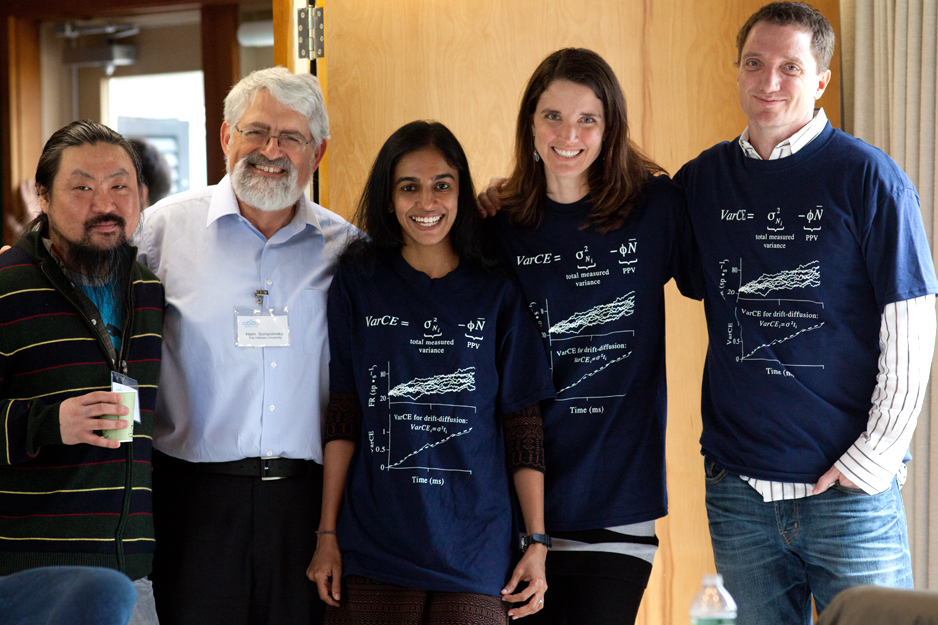
This meeting gathered together a group of people who share an interesting in the variability of cortical neurons. Some, like myself, see neural variability as something that can be useful to experimenters because it provides insight into what neurons are computing. Others see variability as a nuisance that limits the ability of the cortex to represent different things. Still others see variability as being potentially useful to the animal: making it possible for neural circuits to undergo motor learning, for instance. In any event, it was a great group of people and a series of fantastic talks.
Seminar on cortical microcircuits
April 2, 2011

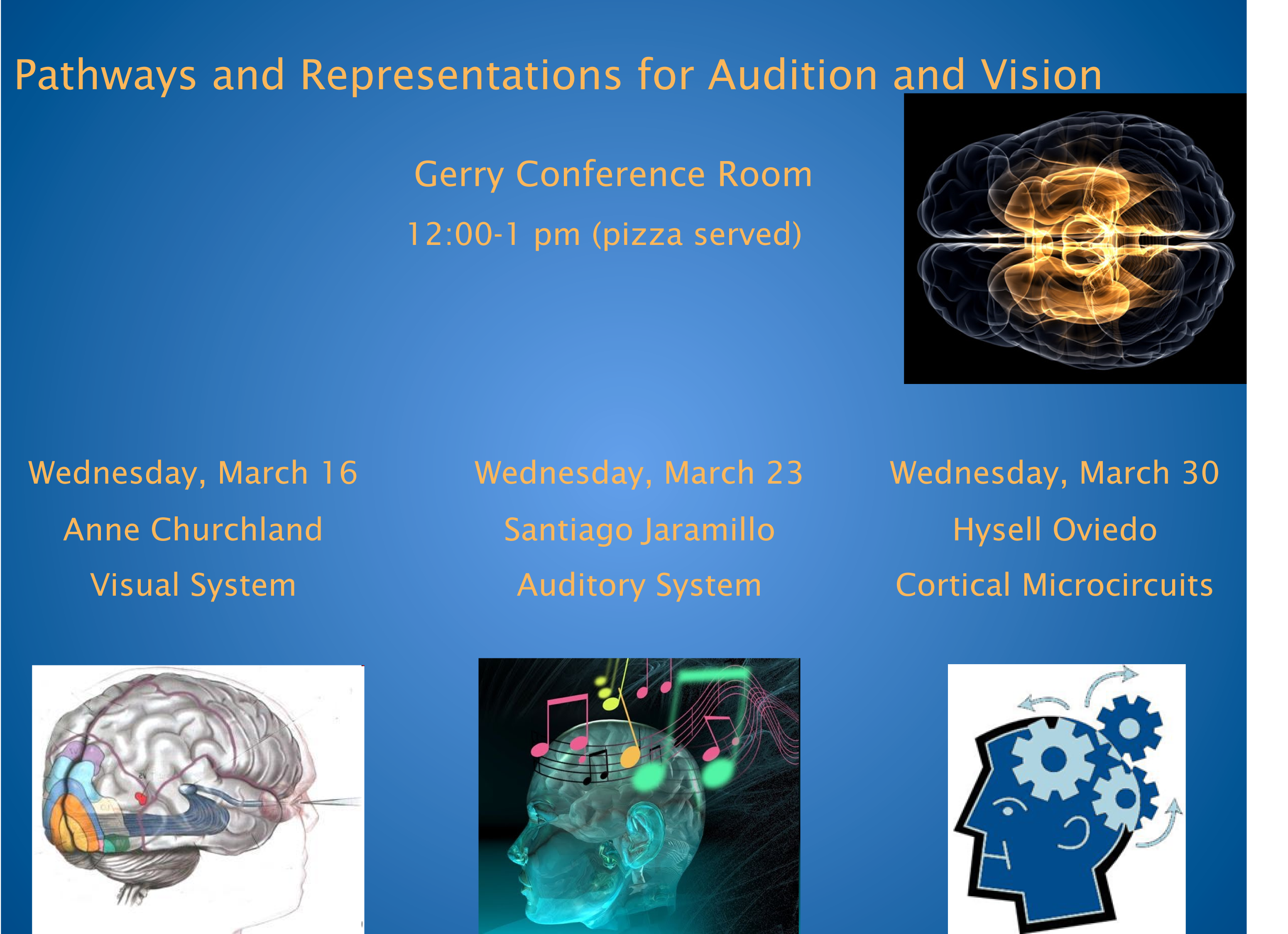
We had the 3rd seminar in our 3-part series this week. Hysell Ovieda gave a lecture entitled, “Cortical Microcircuits; Girls’ Brains are like Spaghetti”. The title was an allusion to a book, “Men’s Brain’s are like Waffles; Women’s Brain are like Spaghetti,” which, Hysell (and Sebastian Seung) argue, is ridiculous because everyone’s brain are “like spaghetti” in the sense that the connections between neurons are numberous and hard to identify. In any event, a high point of the lecture was that Hysell helped us connect the multiple confusing schemes that are out there for classifying inhibitory interneurons. She explained that molecular markers, like parvalbum or somatosstatin, label populations that do not correspond directly to single morphological groups: eg, basket cells. To me, this at first seemed like a big problem. The tools that are now available (cre lines, for example) for controlling specific populations of interneurons, might not be of much use if the cells they stain are mixtures of many populations of inhibitory neurons. Hysell and Tony Zador argued that this wasn’t quite right, however, because, in fact, parvalubumin labelled cells to form something of a consistent group in spite of some variations in morphology.
Concepts and controversies in auditory neuroscience
March 25, 2011
Today we attended the second talk in our 3-part colloquium, “Pathways and representations in auditory and visual cortex.”. The talk was given by Santiago Jaramillo; he highlighted some of the differences between cortical pathways for vision and audition. Perhaps the most pronounced difference that was argued for was the idea that signals in primary auditory cortex are at a much higher level of processing comparedto signals in primary visual cortex.
Building tetrode drives
March 24, 2011
This week, we are building our first tetrode drives in anticipation of recording. Building the drives is a bit of a long process- David made some awesome images to help us remember the details about how the different components go together. 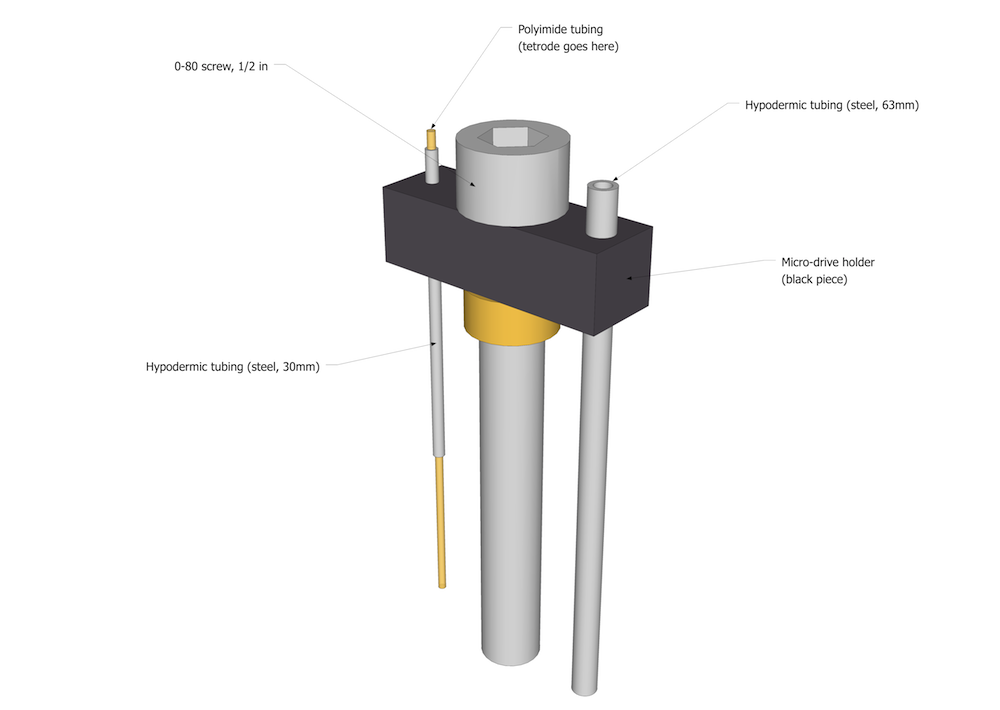
Visit to Goose Hill Elementary School
February 18, 2011
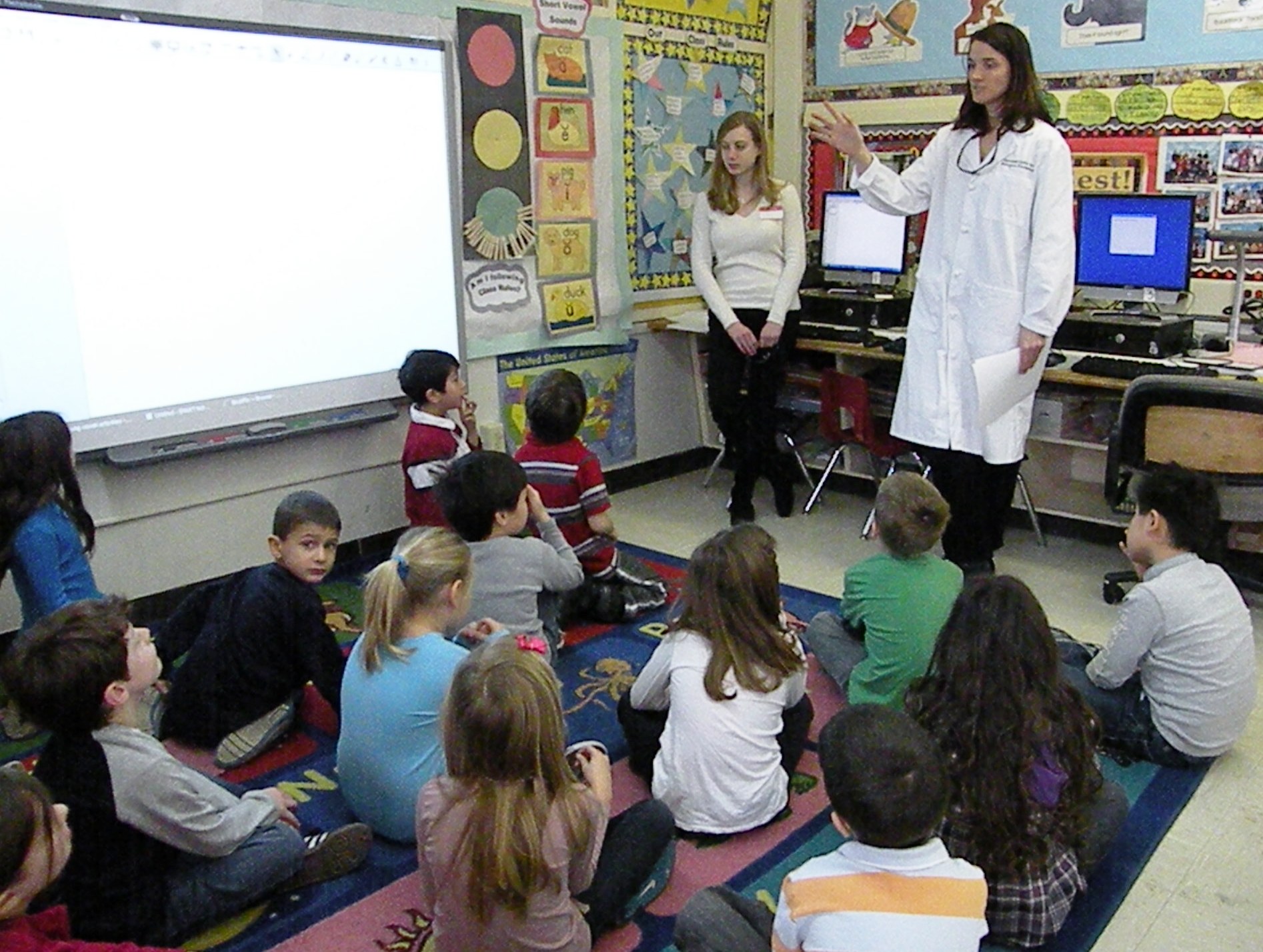
Today we visited the first graders at a local elementary school. We brought in sheep brains and rat brains and did some comparative anatomy. We focussed mainly on sensory systems. The kids were, at first, really nervous about the brains but quickly got over their fears and became extremely enthusiastic.
Visit to NYU to hear Dan Salzman’s seminar
February 14, 2011
We took the train into Manhattan today to hear Dan Salzman (http://www.neuroscience.columbia.edu/?page=28&bio=172) speak at a seminar at NYU. His talk focused on the role of the lateral amygdala and the orbital frontal cortex in aversive and appetitive decisions. We drank fantastic espresso here: http://www.thirdrailcoffee.com/ yummm…
Wine-tasting journal club
February 11, 2011
Today we had a joint lab meeting with Glen Turner’s lab and read Konrad Kording’s recent paper (http://www.nature.com/neuro/journal/v14/n2/full/nn.2731.html). The paper describe how advances in the feasible number of recording electrodes is having an impact on neuroscience. The journal club was followed by a wine-tasting. We tasted 8 different wines (mostly syrah and shiraz). We tasted them all blind so as not to bias our perceptions! The journal club was also attended by a large number of Marks building folks who got wind of either the tasting or the paper- we aren’t sure which!

 Churchland lab